
Last updated on June 6th, 2026 at 12:34 pm
There was a time when an engine could be understood almost entirely through sound, vibration, and mechanical rhythm. A skilled driver or mechanic could listen to a vehicle and sense what was happening beneath the bonnet with surprising accuracy. That relationship between human and machine was physical, analogue, and deeply intuitive.
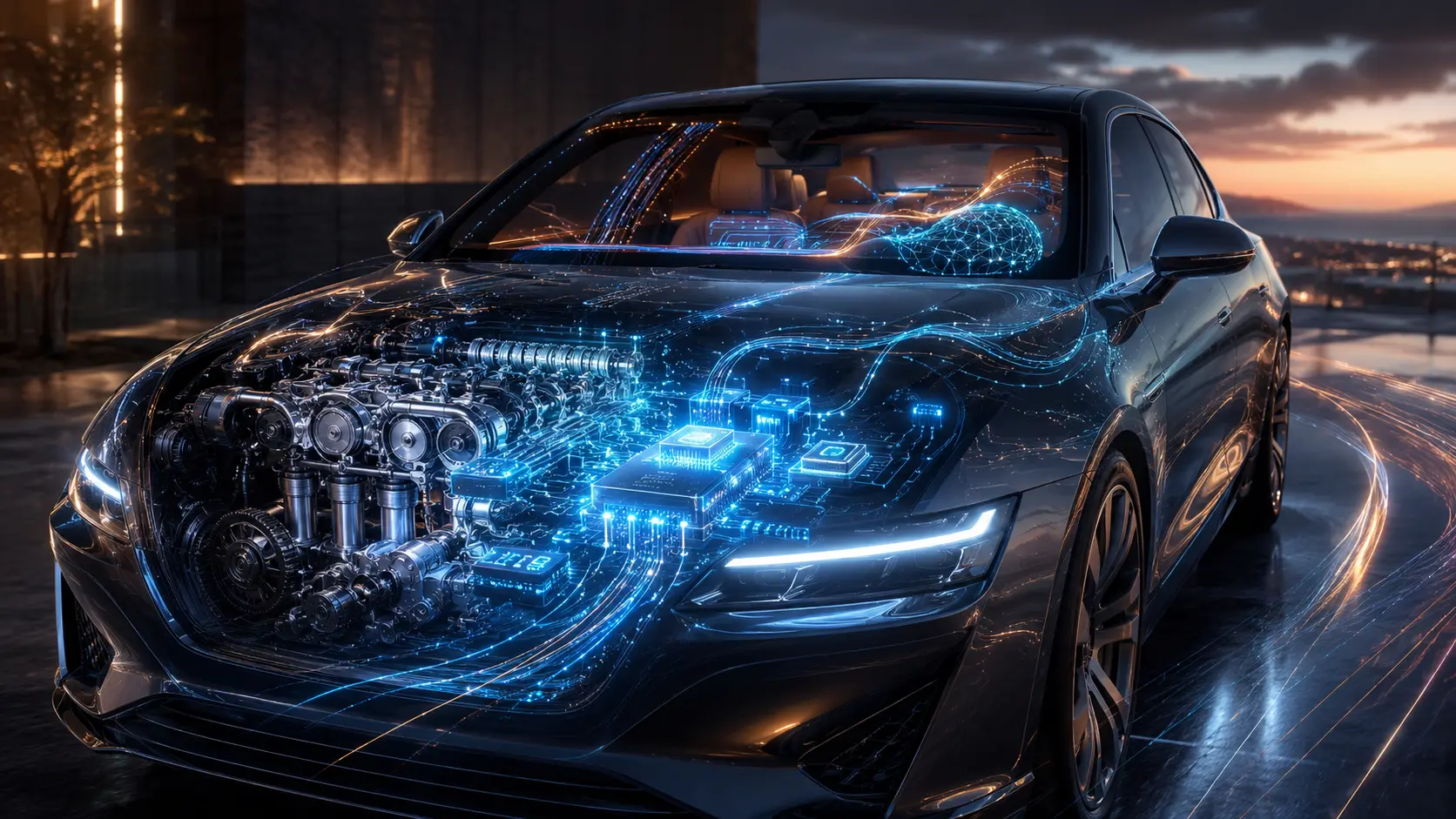
Modern vehicles, however, no longer operate on instinct alone. They operate on instruction sets, sensor networks, and predictive algorithms. The engine has not stopped being mechanical, but it has become something more layered: a computational system that interprets the world as data.
In this shift, the car is no longer just a machine responding to inputs. It is increasingly a machine interpreting context.
From Mechanical Simplicity to Software-Led Behaviour
Traditional combustion engines were defined by relatively direct relationships between fuel, air, ignition, and output. While complex in engineering terms, their behaviour was fundamentally mechanical. A driver pressed the accelerator, fuel was delivered, and the engine responded.
Today’s powertrains—whether hybrid or fully electric—are governed by software layers that constantly adjust performance in real time. Throttle response, energy distribution, torque delivery, and even braking regeneration are mediated through code.
This creates a fundamental change in character. The “feel” of a modern car is no longer purely the result of mechanical design. It is the result of programmed decision-making. Two identical vehicles can behave differently depending on software updates, driving modes, or learned driving patterns.
In effect, the engine is no longer just producing power. It is interpreting intent.
The Engine as a Sensor-Driven System
One of the most significant transformations in modern automotive engineering is the integration of sensors into nearly every aspect of vehicle function. Airflow, temperature, wheel speed, road gradient, traction conditions, and driver input are continuously monitored and analysed.
These data points are not just recorded; they are actively used to adjust behaviour in milliseconds.
For example, traction control systems do not simply react to wheel slip. They predict and pre-empt it based on patterns of behaviour and environmental conditions. Similarly, modern engine management systems continuously refine combustion efficiency or electric power output based on driving style and terrain.
This creates a feedback loop where the engine is constantly learning from its own environment.
Code as the New Mechanical Language
As software becomes central to vehicle function, code effectively replaces many of the roles once played by mechanical tuning alone. Where engineers once adjusted carburettors or mechanical timing systems, they now adjust software maps, control algorithms, and adaptive parameters.
This shift has made vehicles more flexible but also more abstract. The “personality” of a car is increasingly defined by firmware rather than fixed mechanical characteristics.
Performance modes, efficiency settings, and adaptive driving systems all reflect a broader trend: vehicles are being designed as dynamic systems rather than static machines. They can change behaviour over time, respond to usage patterns, and evolve through updates.
The engine, in this sense, is no longer a fixed identity. It is a programmable one.
The Rise of Predictive Driving Intelligence
Modern vehicles are increasingly capable of anticipating conditions rather than simply reacting to them. Navigation data, traffic inputs, and even cloud-based analytics contribute to predictive behaviour.
An electric vehicle, for example, may adjust battery usage based on the route ahead, anticipating elevation changes or congestion. A performance vehicle might pre-condition systems for optimal output based on driving style detected over time.
This predictive capability shifts the role of the engine from reactive force to anticipatory system. It does not just respond to the present moment; it prepares for the next one.
The implications of this are subtle but profound. Driving becomes less about manual control over mechanical output and more about collaboration with a system that is constantly modelling the road ahead.
Emotional Distance and Digital Intimacy
There is a paradox at the centre of this transformation. As vehicles become more digitally complex, they often feel both more distant and more personal at the same time.
On one hand, software layers abstract the mechanical experience. Few drivers today can directly feel how combustion timing or torque vectoring is being managed. On the other hand, adaptive systems that learn from driving habits create a sense of personalisation that older mechanical systems could never achieve.
A car that adjusts steering weight, throttle response, or regenerative braking style based on individual behaviour begins to feel uniquely “tuned” to its driver. Not by a mechanic, but by code.
This creates a new kind of relationship between human and machine—less tactile, but more responsive in subtle ways.
Identity in the Software-Defined Vehicle
As vehicles become more software-driven, the idea of identity within automotive culture is also evolving. What once defined a car—engine size, exhaust note, mechanical tuning—is increasingly complemented by digital characteristics.
Infotainment systems, driving profiles, and connected services all contribute to how a vehicle is experienced. Even visual identity remains important, extending into design details and personalisation choices that reflect ownership style.
In this broader context, companies such as Number 1 Plates exist within an evolving ecosystem where vehicles are treated as expressions of individuality. While the engineering beneath the surface is increasingly software-defined, the human desire for visible identity remains constant.
The result is a layered automotive culture: one part code, one part craftsmanship, and one part personal expression.
When Machines Begin to “Interpret” Driving
Perhaps the most striking aspect of modern engines is not their efficiency or performance, but their interpretive capability. Vehicles are increasingly able to distinguish between casual driving, aggressive acceleration, urban commuting, or long-distance cruising—and adjust accordingly.
This raises an interesting conceptual shift. The engine is no longer just executing commands. It is categorising behaviour and adapting its response based on interpretation.
In older mechanical systems, such nuance would have required manual adjustment. Today, it is handled continuously in real time, often without the driver being explicitly aware of it.
The result is a form of automotive intelligence that sits somewhere between automation and awareness.
Conclusion: The Quiet Transformation of the Engine
The evolution from mechanical instinct to digital intelligence has not replaced the engine—it has redefined it. What was once a purely physical system is now a hybrid of hardware and code, where performance is shaped as much by algorithms as by engineering.
Yet despite this shift, the essence of driving has not disappeared. Instead, it has become more layered. Drivers still seek responsiveness, control, and connection to their vehicles, even if those qualities are now mediated through software.
In this sense, modern engines do not simply produce motion. They interpret it, refine it, and increasingly anticipate it.
They may not literally dream in code, but they are no longer far from systems that behave as if they do.
Also Read
- How First-Time Business Owners Can Get a Loan
- Exploring Life Fitness: The Ultimate Guide to Health and Wellness Equipment
- Why Commercial Cleaning Services Are Essential for Modern Businesses