
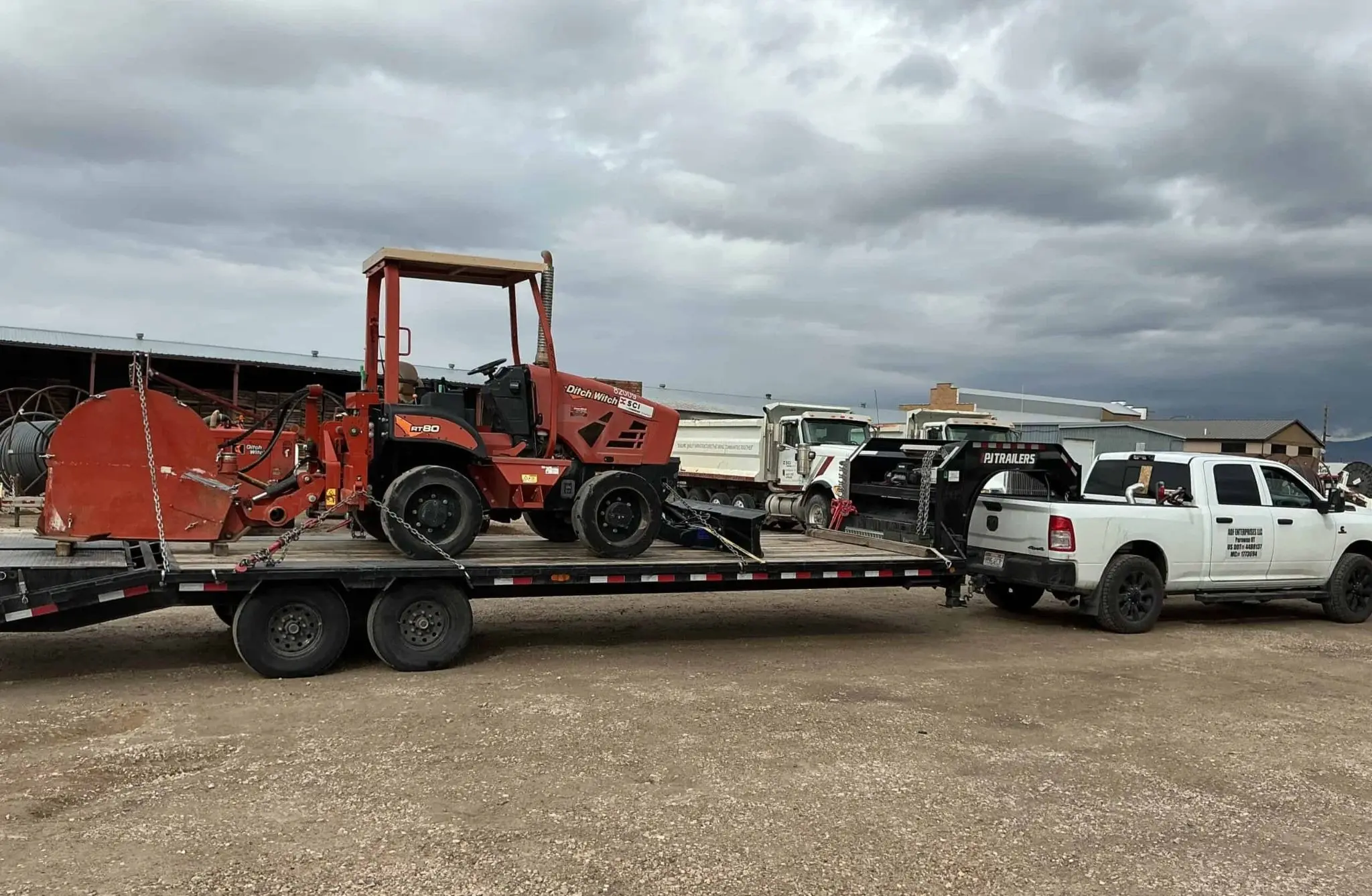
The most effective ways to move equipment fast are evaluating when speed justifies the cost, preparing exact dimensions before calling, verifying route regulations, and choosing a highly communicative carrier.
Mastering these four steps turns urgent equipment transport from a panicked reaction into a controlled operational sequence.
Consider a grading crew whose excavator final drive motor has seized mid-project, with standard LTL freight quoting three to five days and a strict client deadline looming in two.
Picture a farm operator discovering a cracked hydraulic pump right in the middle of harvest season, staring down idle machinery and a rapidly narrowing weather window.
In both scenarios, the real expense is not the repair itself, but the equipment downtime costs.
These expenses include idle labor, equipment rental extensions, strained client relationships, and missed milestones.
At this critical juncture, the framing must shift deliberately. The question is no longer whether the part can be moved, but rather how fast it can reach the job site.
Navigating this logistical hurdle requires a straightforward, four-step approach.
1. Know When to Pay for Speed
When equipment fails, the premium for expedited freight is not simply an expense to avoid, but a business calculation that must be made clearly and quickly.
The core comparison is straightforward. Weigh the daily cost of standing still against the transport premium required to get the component moving.
The costs of an idle site accumulate rapidly through wage waste, rental extensions, liquidated damages, subcontractor rescheduling, and reputational exposure.
Standard shipping infrastructure is often too slow for these critical moments.
When load size and urgency align, businesses running tight operational timelines frequently turn to Titan Worldwide Logistics’ efficient hotshot trucking services.
In these scenarios, faster coordination and transparent communication are built directly into the service itself rather than treated as secondary considerations.
This specific option utilizes lighter-duty pickup trucks pulling flatbed trailers to move critical freight without the heavy overhead of standard dispatch.
As a practical rule of thumb, if the financial cost of delay exceeds two to three percent of the equipment’s total value or the project’s daily revenue exposure, paying for faster freight is almost always the economically correct decision.
Consider a wind farm maintenance supervisor who needed a replacement yaw motor to be moved from Houston to western Oklahoma. Standard shipping methods quoted $340 over a four-day transit.
Instead, an expedited pickup was secured at $1,100, ensuring delivery by 6 a.m. the following morning.
Because turbine downtime was avoided, the wind farm saved over $3,000 in lost generation revenue, making the math required for the transport decision completely unarguable.
Always remember to factor in the indirect costs that rarely appear on a standard freight quote.
Subcontractor rescheduling fees, safety stand-downs, and contract penalties for missed milestones often make the premium for speed the most cost-effective choice available.
| Key Insight: If daily downtime costs exceed 2 to 3% of the equipment value or project revenue, paying for expedited freight is almost always the right decision. |
2. Document Everything Before You Make the First Call
In heavy equipment transport, the most common source of delay is rarely carrier availability or schedule.
Instead, delays usually stem from endless email chains looping back for missing dimensions or unclear pickup conditions.
Compressing the booking window from half a day down to under an hour requires having exact details ready before you even reach out to a logistics coordinator.
Every shipper should have these five data points prepared before contacting any carrier or broker:
- Exact weight: Rely on a scale ticket, spec sheet, or bill of lading. Estimates slow everything down and can lead to immediate rejections at the scale house.
- Dimensions including protrusions: Measure hoses, brackets, ladders, and attachments. Even minor overhangs can push a standard load into permit territory.
- Pickup location specifics: Note site accessibility and available loading equipment, such as whether a forklift, crane, dock, or liftgate requirement is necessary.
- Delivery site conditions: Document any unpaved roads, low-overhead hazards, tight gate clearances, and backing constraints at the destination.
- Photos from multiple angles: A single comprehensive image set eliminates a dozen follow-up questions before they are even asked.
Treating this documentation as a competitive advantage is crucial. Shippers who arrive at the first call with this information fully compiled consistently compress their booking windows.
This gives carriers the confidence needed to commit to a faster dispatch.
3. Map Out Routes and Regulations Before Locking In Pickup
It is easy to forget that the fastest route on a consumer map application is not always a legal or physically possible route for a flatbed carrying heavy machinery.
A load that travels legally in one state may require oversize permits, pilot cars, or daylight travel restrictions just across the border.
These regulatory requirements affect transit time just as directly as total mileage does.
Before locking in a dispatch plan, run through these four route reality check considerations:
- Oversized and overweight permits: State departments handle applications differently based on regional laws.
In Michigan, submitted applications are processed and usually issued within 12 business hours for single-trip permits.
Conversely, some states offer self-issue platforms that remain available 24 hours a day for faster processing.
- Hours of service constraints: A 600-mile move may easily span two driver days under federal regulations.
Drivers face a strict 11-hour driving limit followed by mandatory rest periods, making it important to manage expectations honestly before confirming the pickup.
- Weather and seasonal restrictions: Mountain pass closures, spring thaw weight limits, and storm seasons dictate road availability, impacting both speed and safety.
- Last-mile access: Bridge weight limits between the nearest freeway exit and the delivery point, unpaved final approaches, and tight backing conditions are frequent culprits for late-stage job site delivery delays.
The ultimate goal is not finding the cheapest geographic corridor. Rather, success means planning a legally compliant, physically possible route that guarantees a safe arrival without any expensive roadside surprises.
Taking time to verify these details prevents a truck from being unexpectedly stranded at a weigh station.
| Important: Do not assume the fastest GPS route is legal. Oversized permits often require 48 hours, so check width, height, weight, and last-mile access before booking, or risk expensive roadside delays. |
4. Partner with a Carrier That Communicates Like It Is Part of the Job
There is a clear distinction between a real-time tracking portal and genuine carrier transparency.
A digital map is a convenience, but proactive communication from a transport partner is a vital service.
In time-sensitive shipping, the difference between the two frequently dictates whether a delivery goes smoothly or results in an expensive surprise.
Good carrier communication involves a single point of contact, honest ETAs, and proactive status updates before minor issues become delays.
Same-day dispatch is frequently possible, and typical payload capacity runs up to 10,000 to 12,000 lbs.
Shorter deck lengths make certain transport options the practical choice for single-piece machinery like pumps, motors, gearboxes, and attachments.
A willing partner should recommend better alternatives if the initial dispatch plan is flawed or physically impractical.
Beyond just the mode of transport, look for partners who offer transparent pricing and realistic delivery windows.
They should possess the professional integrity to present alternatives when the first option is not the right match.
Ultimately, in expedited freight, overpromising is just a delayed delivery with a more optimistic start time.
The Bottom Line
When equipment fails, urgency does not have to result in operational chaos. You can stabilize the situation simply by weighing the cost of delay honestly and documenting precise load details before you dial a broker.
Checking the route constraints before you commit and choosing a carrier whose communication matches the urgency of the move are equally critical steps.
The next time a critical component needs to be two states away by tomorrow morning, you will reach for this structured framework rather than relying on a wish.
In specialized freight and heavy equipment transport, fast and reliable are never opposites.
They are simply the direct result of clear information, sound preparation, and making the correct transport decision before the delay becomes an expensive reality.
| Author Profile: Titan Worldwide Logistics is the leading third-party logistics provider of heavy haul trucking and heavy equipment transport solutions for vital industries across North America. |
Also Read
- 4 Practical Ways To Stretch Any Tech Budget
- Business Disputes in Nevada: When to Hire a Business Litigation Attorney
- Exploring Life Fitness: The Ultimate Guide to Health and Wellness Equipment