
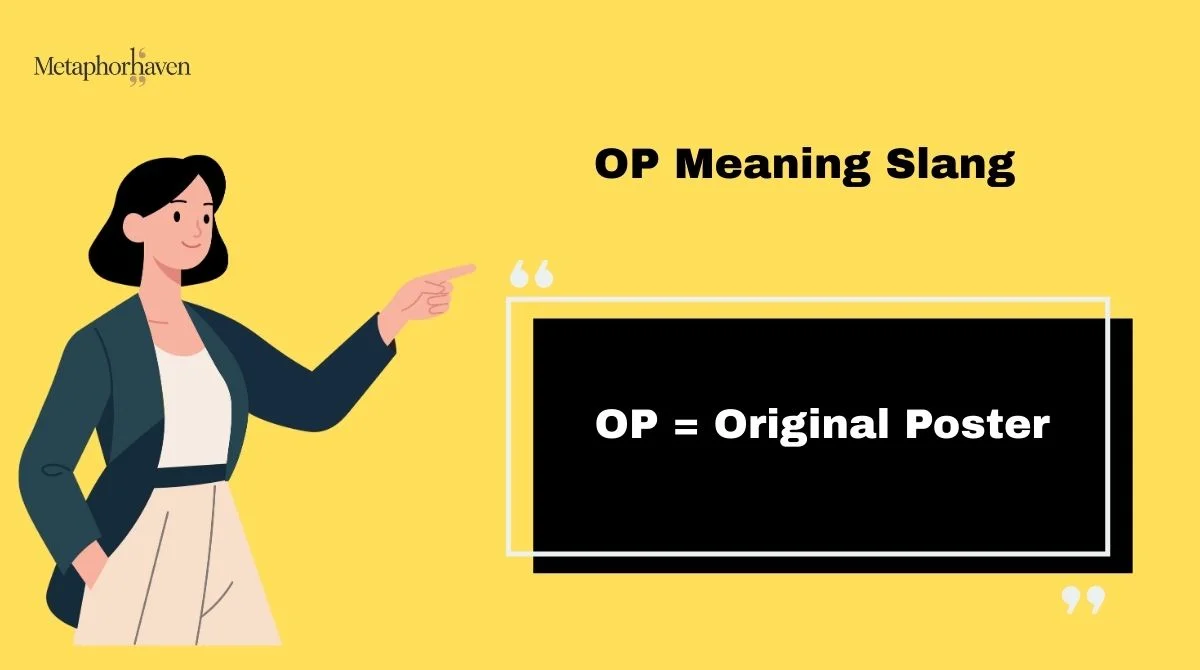
The slang term OP is everywhere online. You’ll see it in chats, comments, memes, and gaming threads. People often search for op meaning slang because the word changes meaning based on where it’s used.
Sometimes it means someone is too powerful. Other times, it refers to the person who made the post.
This can feel confusing, especially if you’re new to internet slang or gaming culture. OP is short, quick to type, and fits perfectly into fast conversations on social media.
That’s why it spread so fast. In this guide, you’ll learn what OP really means in text and chat, where it came from, how people use it today, and how to reply when someone says it to you.
Let’s break it down in simple words.
What Does OP Mean in Text & Chat?
In text and chat, OP usually has two common meanings. The meaning depends on the platform and the context of the message.
1) OP = Original Poster
This is common on forums and comment sections. OP means the person who made the first post or thread.
People use it when they talk about that person.
Examples:
- “OP explained this really well.”
- “Thanks, OP, that helped a lot.”
- “I agree with OP on this.”
2) OP = Overpowered
This meaning comes from gaming slang. OP describes something that is too strong, unfair, or broken.
Examples:
- “That weapon is OP 😅”
- “Your character build is OP.”
- “This skill feels OP after the update.”
Quick scan examples:
- “OP is right here.”
- “This move is OP 🔥”
- “Ask OP for details.”
So, when you see OP in chat, look at the topic. Is it about a person or about power? That’s your clue.
Full Form, Stands For & Short Meaning of OP
OP doesn’t have just one full form. It changes based on how people use it online.
Main meanings of OP:
- Original Poster → the person who made the post
- Overpowered → too strong or unfair in games
Short meanings in simple words:
- OP (person): “the one who posted this”
- OP (thing): “too strong” or “too good”
How people write it:
- OP
- op
- Op
All forms mean the same thing in casual chat. People don’t care about capitalization much.
Bullet examples:
- “OP nailed the explanation.”
- “This character is OP 😎”
- “Ask OP for the source.”
If you’re unsure which meaning fits, read the full sentence. The context always makes it clear.
Origin, History & First Known Use of OP
The slang OP has two different origins that merged online over time.
Original Poster came from early internet forums. On message boards, people needed a quick way to talk about the person who started a thread. Typing “original poster” was slow. So, OP became the short form.
Overpowered came from gaming culture. Gamers needed a fast word to describe weapons, characters, or abilities that felt unfair. OP was perfect for quick reactions during matches and in chat rooms.
As social media grew, both meanings spread everywhere. Now you’ll see OP used on forums, gaming chats, group messages, and comment sections. The same two letters took on two popular meanings, and both survived because they’re useful.
Quick facts:
- Forums → OP = Original Poster
- Games → OP = Overpowered
- Social media → both meanings
That’s why OP can feel confusing at first. It grew in two places at the same time.
How People Use OP in Daily Conversations
People use OP in casual, fast conversations. It saves time and feels natural online.
In daily chat, OP is used to:
- Refer to the person who posted something
- Praise or complain about something being too strong
- Agree with the original idea
Examples in casual chat:
- “OP explained it better than anyone.”
- “That filter is OP 😂”
- “OP has a point here.”
Quick scan bullets:
- “OP deserves credit.”
- “This combo is OP 🔥”
- “Ask OP what they meant.”
People rarely explain OP anymore because it’s widely understood. If someone doesn’t get it, others usually explain it in the replies.
OP Meaning Across WhatsApp, Instagram, TikTok & Snapchat
OP keeps the same meanings, but the way people use it changes by platform.
- Mostly used as Overpowered
- “That sticker pack is OP 😂”
- Used for both meanings
- “OP’s caption is so real.”
- “This edit is OP 🔥”
TikTok
- Very common in comments
- “OP is right about this.”
- “This sound is OP 😭”
Snapchat
- More casual, playful use
- “Your filter is OP 😅”
Quick scan examples:
- “OP did not lie.”
- “This trick is OP.”
- “Shoutout to OP 👏”
No matter the app, OP stays short, fast, and expressive.
Different Meanings of OP in Other Fields
OP can mean different things outside slang. This is where confusion happens.
Other meanings of OP:
- Operation (medical or military context)
- Opinion (rare shorthand in casual chat)
- Overpowered (gaming)
- Original Poster (forums and social media)
Examples:
- “The OP went well.” (operation)
- “That’s my OP.” (opinion, uncommon)
- “This boss is OP.” (gaming)
- “OP asked a good question.” (forums)
Tip:
If OP is used in slang, it’s almost always Original Poster or Overpowered. The other meanings depend on context and are less common in chats.
Common Confusions, Mistakes & Wrong Interpretations
People often mix up the two main meanings of OP. This leads to funny or awkward replies.
Common mistakes:
- Thinking OP always means “overpowered”
- Thinking OP always means “original poster”
- Using OP in formal writing
Wrong example:
- “OP needs to fix this bug.”
(Do you mean the poster or something too strong?)
Better example:
- “The weapon is OP and needs a nerf.”
- “OP needs to clarify their point.”
Quick scan tips:
- Look at the topic
- Check if it’s about a person or a thing
- If unsure, ask politely
Similar Terms, Alternatives & Related Slang
Here are words people use instead of OP, depending on the meaning.
For “Original Poster”:
- Thread starter
- The poster
- The author
For “Overpowered”:
- Broken
- Too strong
- Meta
- Cracked
Related slang (internal linking ideas):
- lol meaning slang
- fr meaning in chat
- hmj full form
- llj meaning texting
Quick scan examples:
- “That move is broken.
- “The thread starter explained it well.”
Examples of OP in Real Chat Situations
Here’s how OP looks in real messages:
- “OP explained it perfectly.”
- “That skin is OP 🔥”
- “Ask OP for the source.”
- “This combo is OP 😅”
- “OP’s story makes sense.”
These short lines show how natural OP feels in daily chat.
How to Reply When Someone Says OP
Your reply depends on how OP is used.
If OP means Original Poster:
- “Thanks! Glad it helped 😊”
- “Appreciate it!”
- “Happy to explain more.”
If OP means Overpowered:
- “Yeah, it needs a nerf 😂”
- “True, it’s way too strong.”
- “They should balance it.”
Quick replies:
- “Facts.”
- “Agreed.”
- “Lol, true 😅”
Is OP Still Popular? Trends & Online Usage
Yes, OP is still very popular. It stays useful because it’s short and clear. New slang comes and goes, but OP sticks around. Gamers use it daily. Comment sections use it nonstop. It works across platforms and cultures.
Why OP stays popular:
- Fast to type
- Easy to understand
- Works in many contexts
- Fits short-form content
You’ll keep seeing OP in comments, memes, and chats for a long time.
FAQs About OP Meaning Slang
1. What does OP mean in slang?
It means Original Poster or Overpowered, based on context.
2. Is OP rude?
No. It’s neutral slang.
3. Can OP mean something bad?
Only if used in a negative sentence. The word itself isn’t bad.
4. Is OP used in formal writing?
No. It’s casual internet slang.
5. How do I know which OP meaning is correct?
Check if the message talks about a person or something being too strong.
Conclusion
The slang term OP is short, flexible, and super common online. That’s why so many people search for op meaning slang.
In simple terms, OP either points to the Original Poster or describes something as Overpowered.
The meaning depends on the context and platform. Once you know these two uses, OP becomes easy to understand. You’ll spot it in comments, gaming chats, and everyday messages.
If you’re unsure, just read the full sentence. The meaning usually becomes clear.
Now you can read chats with confidence and even use OP naturally in your own replies. Internet slang changes fast, but OP isn’t going anywhere anytime soon.
I am Rani, a passionate writer who loves exploring metaphors and creative expressions in English.Through words, I aim to make language more vivid, meaningful, and inspiring.
