
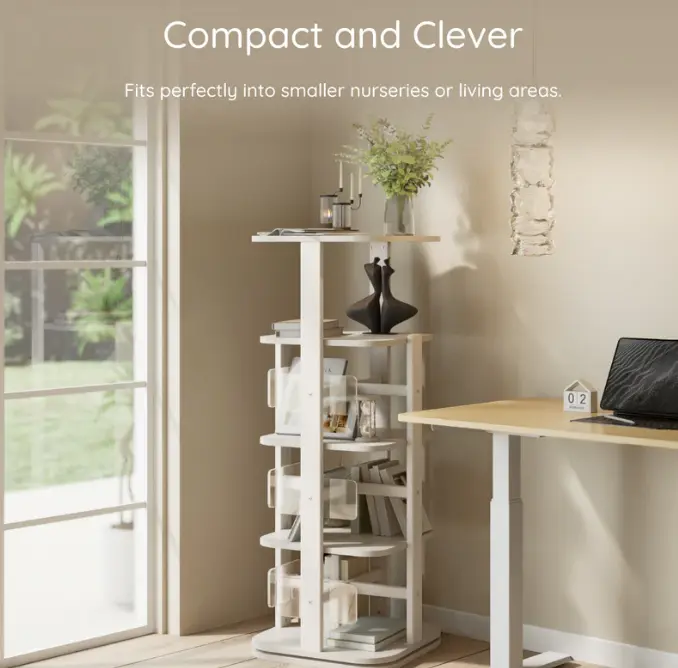
A rotating bookshelf for kids is a freestanding storage unit that spins on a central axis, giving children access to books on all sides from a single standing position. For families dealing with a small bedroom, a compact reading corner, or a child who walks past a standard shelf without engaging with it, the rotating format solves real problems that a flat wall-mounted shelf cannot. It puts more books within reach in less floor space and gives children a reason to interact with the shelf rather than ignore it.
Key Takeaways
- A rotating bookshelf for kids makes all stored books accessible from one spot, which suits small rooms and reading nooks particularly well.
- The spinning mechanism encourages children to browse actively rather than glancing at one fixed face of books and walking away.
- Base stability is the single most important quality factor. A wide, weighted base with controlled rotation is non-negotiable for safety.
- Front-facing slots on each panel work far better than spine-out shelving for children under six.
- Placement in open space rather than against a wall makes the most of what a rotating design offers.
Why Children Engage More with a Rotating Bookshelf
A standard bookshelf presents one fixed face. Once a child has looked at what is visible and nothing immediately appeals, they move on. The shelf fades into the background. A rotating design changes that interaction entirely. The child can stand in one place and work through every book on the shelf simply by giving it a gentle spin, which keeps them at the shelf longer and increases the chance they find something they want to read.
There is also something enjoyable about a shelf that responds to touch and movement. Young children are drawn to interactive elements in their environment, and a shelf that spins gently when pushed sits naturally in that category. It makes the act of choosing a book more engaging before the reading even begins.
Types of Rotating Bookshelves for Kids
| Type | Best For | Age Range | Key Advantage |
| Four-panel front-facing | Picture books and board books | 1 to 5 years | Covers visible from every angle |
| Four-panel spine-out | Chapter books | 6 years and up | Higher capacity per panel |
| Mixed panel design | Transitional collections | 3 years and up | Works across book formats |
| Two-tier low rotating shelf | Small rooms, limited collections | 1 to 4 years | Very stable, low profile |
| Tall multi-tier rotating | Larger collections | 5 years and up | Maximum capacity, small footprint |
What to Look for When Buying a Rotating Bookshelf for Kids
Base Stability
This is the most important factor by a significant margin. A rotating bookshelf introduces movement that a standard shelf does not have, and that movement needs a base solid enough to stay grounded when a child spins it enthusiastically or leans against a panel while browsing. Look for a base diameter at least half the total height of the unit, non-slip rubber feet, and a rotation mechanism with enough resistance that the shelf holds its position when the child stops spinning it rather than continuing to drift.
The Rotation Mechanism
Quality varies considerably between models and it becomes obvious within the first few weeks of use. A good mechanism spins smoothly without grinding, holds position when released, and stays consistent over months of daily handling. Mechanisms that loosen with use and develop a wobble are a common issue in lower-quality rotating shelves. Read reviews specifically about how the mechanism performs after six to twelve months, not just how it feels when brand new.
Shelf Panel Design
For children under six, front-facing panels are significantly more effective than spine-out shelves. A qualityrotating bookshelf for kidsdesigned for young children will have panel slots with a lip at the base of each slot to stop books sliding out when the shelf spins, shallow enough depth that books do not disappear toward the back, and enough spacing between slots to hold picture books upright without flopping.
Materials and Finish
- Solid timber or quality MDF with reinforced panel joins.
- Non-toxic, lead-free paint or lacquer finish certified to Australian safety standards.
- Smooth, rounded edges on every panel and shelf lip.
- A fully enclosed rotation mechanism so small fingers cannot reach any moving parts.
How to Set Up a Rotating Bookshelf
- Position it away from walls. A rotating shelf pushed into a corner loses most of its advantage. Place it in the centre of a reading area so the child can walk around all sides.
- Load the lowest panels with current favourites. Whatever the child reaches for most often should be at eye level and immediately accessible.
- Fill each panel to about two-thirds capacity. Tightly packed slots are harder to browse and harder for children to return books to neatly.
- Rotate the book selection every four to six weeks. Swapping titles from storage keeps the shelf feeling fresh without buying new books.
- Keep non-book items off the panels. Objects wedged into book slots stop the shelf spinning cleanly and reduce usable display space.
Frequently Asked Questions
From what age can children use a rotating bookshelf?
From around 18 months, a low rotating bookshelf with front-facing panel slots is appropriate. The key requirements at this stage are a stable base, a low overall height, and slots sized for board books that the child is already handling.
How do I stop a rotating bookshelf from tipping?
Choose a model with a wide, weighted base and non-slip feet. Keep heavier books on the lower panels to maintain a low centre of gravity and avoid overloading upper panels. Some models include an optional floor fixing point for additional security, which is worth using in a young child’s room.
How many books does a rotating bookshelf hold?
Most children’s rotating bookshelves with four panels and three to four rows per panel hold between 40 and 80 picture books depending on thickness. That is enough for a healthy active rotation without overwhelming the child with too many choices at once.
Is a rotating bookshelf better than a standard one?
Neither is universally better. A rotating shelf wins on space efficiency, accessibility from all angles, and engagement for young children. A standard bookshelf wins on raw capacity and stability. Many families use both: a rotating shelf for the active daily reading selection and a standard bookcase for storing the broader collection.
Final Thoughts
A rotating bookshelf earns its place in a child’s room by doing more with less floor space and making book browsing genuinely interactive. The spinning element is not a novelty. It changes how children relate to the shelf and how often they reach for a book on their own. For Australian families looking for children’s furniture that combines smart design with everyday practicality, a well-made rotating bookshelf for kids is one of the better additions you can make to a child’s bedroom.
Also Read-Comprehensive Guide to Home Protection Plans: Safeguarding Your Home from Pests


