
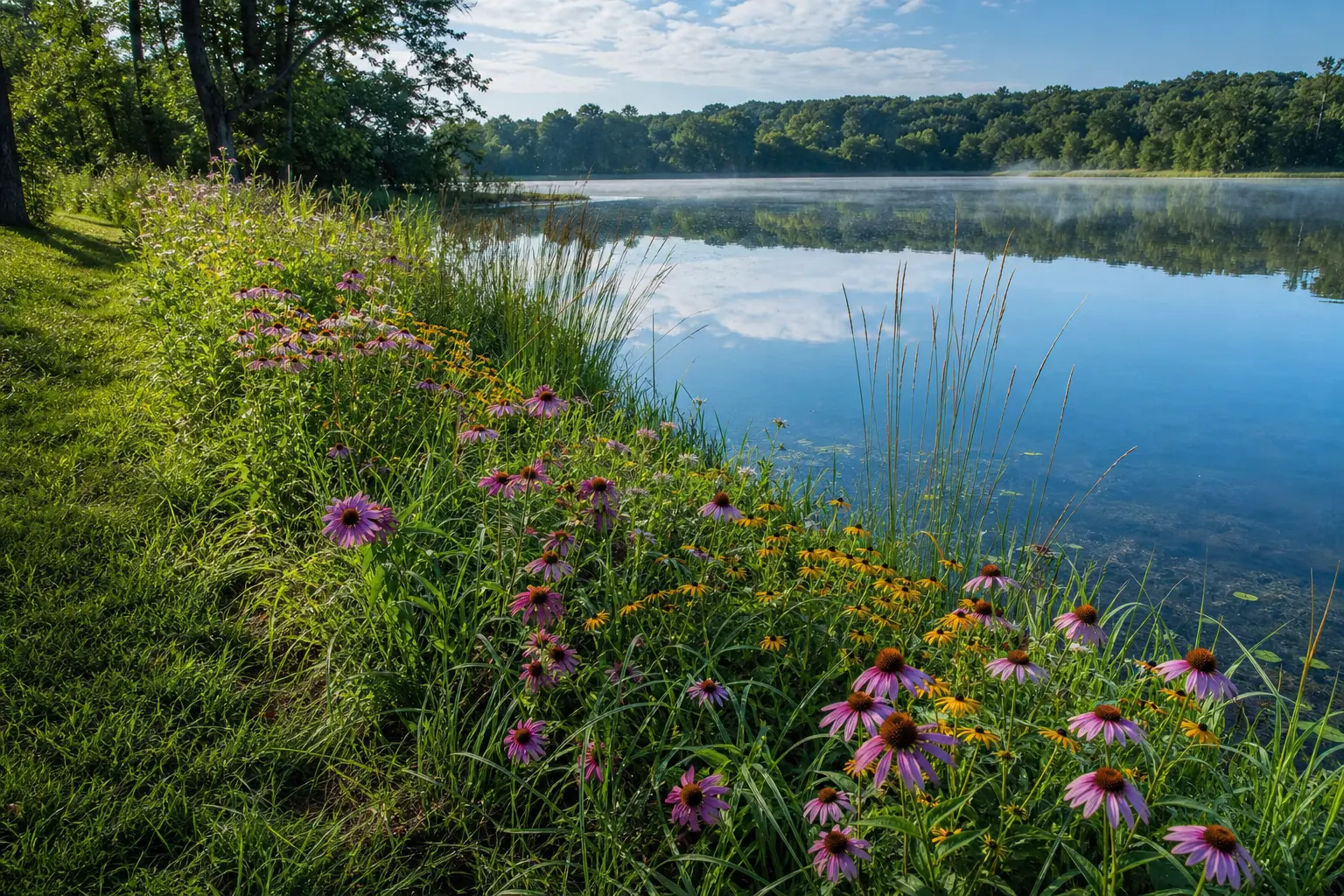
The four secrets to clear murky pond water naturally include adding bottom diffused aeration, cutting off nutrient runoff, applying biological muck treatments, and introducing gentle surface circulation.
These low-effort methods work together to restore aquatic balance, break down organic sludge, and starve algae without relying on harsh chemicals.
You walk out to your large property pond on a warm morning expecting a peaceful surface, only to find a green haze, a faint swamp smell, and floating mats.
This murky pond water is not a single failure. It is what happens when a biological system falls out of balance, allowing the water ecosystem to shift in favor of the wrong organisms.
As nutrients accumulate and oxygen drops, the environment degrades rapidly. The common culprits are decaying organic matter on the pond floor, runoff carrying lawn fertilizer, excess fish waste, and warm stagnant water.
Fortunately, the most effective fixes are also the lowest effort ones because they simply restore what the pond is naturally trying to do on its own.
By understanding how to clear a pond naturally, you can achieve a pristine water feature with minimal ongoing intervention.
1. Let the Water Breathe Without Lifting a Finger
Dissolved oxygen is the biological engine of a healthy pond. When oxygen is plentiful, beneficial bacteria thrive, organic matter breaks down efficiently, and algae loses its competitive advantage.
Aeration is simply the process of moving oxygen into the water and circulating it so that no stagnant, oxygen-depleted dead zones form along the bottom.
A bottom diffused aerator handles this process effortlessly. A diffuser sits on the pond floor, releases fine air bubbles that rise through the water column, and continuously pulls oxygen-poor bottom water up toward the surface.
This continuous turnover ensures the pond’s entire depth becomes active. In fact, most pond systems release phosphorus from sediments when the dissolved oxygen concentration falls below 1 mg/L.
The pond aeration benefits are immediate and compounding over time. Beneficial bacteria multiply rapidly to consume accumulated muck, while algae lose the nutrient surplus it needs to bloom.
To maintain good health, warmwater fish require a concentration of at least 5 mg/L of dissolved oxygen.
The water column becomes self-regulating, allowing fish to cruise visibly at deeper levels without requiring manual labor or harsh chemicals.
For a large property pond, property owners can explore solar units or a pond aerator for oxygen restoration from Everblue Pond.
These systems support the conditions that keep water clear season after season without demanding manual effort from you.
Continuous aeration is a low-effort upgrade that amplifies every other pond clearing strategy.
| Key Insight: Your pond’s clarity depends on giving beneficial bacteria enough oxygen to do their job. Bottom-diffused aeration works silently around the clock and is the one upgrade that amplifies every other pond-clearing effort. |
2. Starve the Algae Instead of Fighting It
Algae is not the primary problem because it is merely a symptom of a larger imbalance. If you remove its food supply, it retreats naturally without the need for endless chemical treatments.
The most common nutrient sources include lawn fertilizer runoff, grass clippings blown into the water, goose droppings along the bank, and overfeeding fish.
Addressing this pond nutrient buildup stops the cycle at its source.
The first fix is planting a native buffer strip three to five feet wide around the pond’s edge.
Grasses and wildflowers intercept runoff before it reaches the water and require virtually no ongoing maintenance once established.
Second, switch to phosphorus-free fertilizer on adjacent lawn areas, or simply stop fertilizing that specific boundary zone altogether.
In many water systems, algae feed on excess nutrients, growing, spreading, and turning the water completely green.
When these large blooms die off, bacteria decompose them and consume massive amounts of vital oxygen.
Third, add floating aquatic plants or create a shallow planted shelf inside the margin to passively consume the same nutrients algae need to survive.
Finally, stop overfeeding your fish since uneaten food fouls the water within minutes and adds to the nutrient load.
When you cut off these sources, algae control for ponds becomes a passive process. This natural starvation approach is how to clear a pond naturally in the truest sense.
| Quote: “A pond that’s fed properly doesn’t grow algae. Every ounce of lawn fertilizer that runs into the water is an invitation for a bloom.” |
3. Manage Muck Without the Muscle
The layer of dark sludge along the pond floor is not just unsightly for property owners.
It acts as a nutrient battery, continuously releasing algae food upward into the water column and contributing to poor clarity through suspended particles.
This muck consists of compressed layers of decomposed leaves, dead algae, fish waste, and fine sediment that have settled over several seasons.
Physical dredging is an expensive and highly disruptive process that removes the pond from use for days.
Conversely, biological pond muck treatment works silently over a matter of weeks without any of that hassle.
Concentrated beneficial bacteria and enzyme-based microbes are introduced into the water, where they colonize the organic material on the bottom.
These organisms break down the sludge into harmless water and gases while the pond does the heavy lifting.
The property owner simply applies a measured dose monthly to maintain the bacterial colony.
Over a consistent warm season of treatment, the muck layer shrinks gradually, the bottom firms up noticeably, and the water becomes progressively clearer.
These biological treatments accelerate significantly when paired with robust aeration.
Healthy pond oxygen levels activate beneficial bacteria, allowing them to work at full capacity to eliminate stagnant pond water conditions.
Sizing these biological solutions accurately ensures you apply the right concentration for your water volume.
4. Keep Things Moving For The Low Effort Surface Fix
Stillness is the environment where aquatic problems compound quickly and visibly. A motionless surface accumulates a stagnant film, creates ideal breeding conditions for mosquitoes, and allows warm surface water to sit undisturbed.
This environment is exactly where filamentous algae and duckweed prefer to anchor and multiply rapidly.
Improving pond circulation is a complementary strategy that completes the water quality puzzle. Gentle circulation moves floating debris toward the bank, where it can be removed easily.
It also integrates water temperature evenly throughout the column and discourages surface algae from establishing a foothold.
Depending on your property layout, options include sub-surface water circulators, small surface aerating units, or aerating fountains if visual impact is a priority.
There is no heavy machinery required for this fix. Consistent, gentle movement makes a measurable difference in overall pond water clarity.
When a pond is circulating correctly, the surface reflects light cleanly and naturally. The odors associated with stagnant pond water fade away completely.
Ultimately, the water takes on the beautiful, healthy quality you originally envisioned.
Putting It All Together
The real insight behind these strategies is not that they are mere shortcuts. It is that they work in harmony with the pond’s natural biology rather than fighting against it, which means they require far less effort over time.
Before choosing a starting point, take a moment to assess your primary pain point.
If the pond smells bad and bottom sludge is highly visible, begin with aeration paired with a biological muck treatment.
If the water turns green immediately after heavy rain, prioritize nutrient reduction alongside aeration.
If the surface looks filmed over but the water below seems decent, start by introducing gentle circulation.
Aeration is almost always the best foundational investment because oxygen acts as a multiplier that amplifies the effectiveness of every other strategy.
Remember to match your system capacity to your pond’s specific size, depth, and volume. A correctly matched system runs quietly, uses modest electricity, and allows your pond to ultimately maintain itself.
| Author Profile: Everblue Pond offers a broad selection of large pond, commercial lake, and water-feature equipment for landowners, farmers, acreage owners, ranch owners, large property owners, golf course managers, pond managers, and property managers who want cleaner water, healthier ecosystems, and dependable year-round operation. |
Also Read
- The Hidden Financial Risks of Rapidly Scaling a Business
- A Life in Transit: What Moving Teaches Us About Permanence
- 4 Simple Fixes To End Vaginal Dryness