
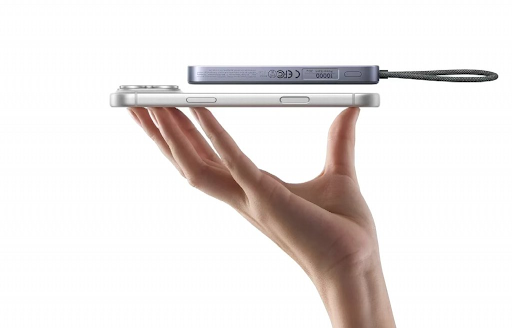
Smartphones, tablets, and laptops are essential for daily life, but their usefulness still depends on battery life. Choosing a power bank means balancing capacity with portability: higher capacity provides more reserve but usually adds bulk, while compact models are easier to carry but may not last through longer trips.
This guide explains what mAh ratings mean, how capacity translates into real-world use, and how to choose the right size for your routine.
What Does mAh Mean on a Power Bank?
Power bank capacity is usually measured in milliampere-hours, or mAh. In simple terms, a higher mAh rating means the battery can store more electrical charge.
However, mAh is not the only useful measurement. Watt-hours, or Wh, account for battery voltage and are particularly important when comparing larger power banks or checking airline restrictions.
Wh = (mAh × Voltage) / 1000
For example, a 10000mAh battery using cells with a nominal voltage of 3.7V stores approximately 37Wh of energy.
Common Power Bank Capacity Ranges
Capacity ranges provide a useful first filter:
- Under 5000mAh: Best for emergency top-ups, short outings and minimum weight.
- 5000mAh to 10000mAh: Well suited to commuting, everyday phone charging and day trips.
- 10000mAh to 20000mAh: Better for weekends away, heavier smartphone use or several smaller devices.
- 20000mAh and above: More suitable for laptops, tablets, multi-device charging and longer periods away from mains power.
The largest capacity is not automatically the best choice. A smaller charger you carry regularly may be more useful than a large battery pack that rarely leaves home.
Rated mAh also does not directly equal the amount of charge your phone will actually receive.
Why Rated Capacity Is Not the Same as Usable Capacity
A 10000mAh power bank does not deliver the full 10000mAh directly to your phone. Some stored energy is lost before it reaches the connected device.
Common factors include:
- Voltage conversion: Internal battery voltage must be converted to the output required by the device.
- Heat: Part of the stored energy is lost as heat during charging.
- Electrical resistance: Cables and internal circuitry introduce unavoidable losses.
- Wireless charging: Wireless charging generally involves greater energy losses than wired charging.
- Temperature: Very hot or cold conditions can affect charging efficiency.
- Device activity: Navigation, gaming, video and other demanding tasks continue to consume power while charging.
As a broad reference, usable output will always be lower than the nominal mAh figure, but the exact difference depends on voltage, charging method, hardware and operating conditions.
For example, it is not accurate to assume that a 10000mAh power bank will charge a 3000mAh phone more than three times simply by dividing one mAh figure by the other.
For more meaningful comparisons, look at Watt-hours, rated output capacity and manufacturer-provided charging information alongside nominal mAh.
Does Fast Charging Affect Power Bank Performance?
Fast-charging technologies such as USB Power Delivery and PPS allow compatible devices to receive higher power and reduce charging time.
Higher charging power can also generate more heat and conversion losses, so the highest wattage is not automatically the most useful specification for every user.
When comparing fast-charging power banks, consider:
- The maximum charging power required by your phone, tablet or laptop
- USB PD or PPS compatibility
- Cable capability
- Power distribution when multiple ports are in use
- Heat generated during higher-power charging
The practical approach is to match output power to the devices you actually use rather than automatically choosing the highest wattage available.
Power Bank Size and Weight vs Capacity
Higher-capacity power banks generally require larger or additional battery cells. High-density battery designs can reduce physical size to some extent, but they cannot eliminate the basic relationship between stored energy and bulk.
High-output models may also require additional power-management and thermal components. A 20000mAh power bank intended for laptop charging will therefore normally be larger and heavier than a compact phone charger.
When Does a Slim Power Bank Make More Sense?
For commuting, sightseeing, festivals, shopping or evenings out, portability may matter more than maximum capacity.
As a general guide:
- Around 5000mAh: Prioritises minimum size and weight and works well for emergency charging or short outings.
- Around 10000mAh: Provides more reserve for long workdays, navigation, photography, streaming and travel while remaining relatively portable.
Beyond capacity, useful factors to compare include:
- Thickness and overall weight
- Wired or wireless charging
- Built-in charging cables
- Charging output
- Port selection
- Device compatibility
Readers who prioritise a thinner, travel-friendly form factor can compare Slim Power Banks to see how capacity, charging methods and dimensions vary across compact portable designs.
The goal is not simply to find the smallest charger available, but to choose enough capacity without undermining the portability that makes a slim design useful.
Which Power Bank Capacity Is Best for Your Routine?
Once you understand the relationship between capacity and portability, the easiest way to choose is to start with how you normally use your devices.
Daily Commuting: 5000mAh to 10000mAh
For most commuters, a power bank mainly serves as backup against a phone running flat before the end of the day.
A lighter 5000mAh option may be enough if you usually have access to mains power at home or work.
A 10000mAh option may be more useful when your typical day includes:
- Navigation
- Photography
- Video streaming
- Mobile hotspot use
- Frequent messaging
- Longer periods away from a socket
The right choice depends more on your daily usage pattern than on choosing the largest number available.
Weekend Travel: 10000mAh to 20000mAh
For weekends away, festivals, train journeys or short holidays, access to mains charging may be less predictable.
A 10000mAh to 20000mAh power bank can provide more flexibility if you need to support:
- A smartphone
- Wireless earbuds
- An e-reader
- A camera
- Other small USB devices
Additional capacity also means more weight. If your main priority is keeping one smartphone running, a compact 10000mAh model may provide a better balance than carrying a larger battery you are unlikely to use fully.
For readers comparing compact charging options for longer journeys, this guide to slim power banks for travel and daily carry provides additional context on portability, capacity and charging methods.
Remote Work and Laptop Charging: 20000mAh+
Laptop users need to consider more than capacity alone.
Before choosing a power bank, check:
- Your laptop’s required charging wattage
- Maximum USB-C output
- Whether USB PD is supported
- How power is shared between ports
- Whether several devices can be charged simultaneously at useful speeds
Higher-capacity models therefore make more sense for remote workers, business travellers and users who regularly need to power laptops or several demanding devices away from mains power.
| Typical Use Case | Capacity to Consider | Main Priority |
| Emergency backup / short outings | Around 5000mAh | Minimum size and weight |
| Daily commuting | 5000mAh–10000mAh | Portable everyday charging |
| Weekend travel | 10000mAh–20000mAh | More reserve for longer trips |
| Laptop / multi-device use | 20000mAh+ | Capacity plus sufficient USB-C output |
These ranges are guidelines rather than fixed rules. Device battery size, daily usage, access to mains power and preferred carrying weight should ultimately determine the right capacity.
Power Banks and UK Air Travel
Capacity also matters when travelling by air because power banks contain lithium batteries and are subject to aviation safety requirements.
Under current UK Civil Aviation Authority guidance:
- Power banks should be carried in cabin baggage rather than checked luggage.
- They should be protected against short circuits when not in use.
- Passengers should follow applicable limits on the number and capacity of spare lithium batteries or power banks.
- On-board use and recharging may be restricted depending on current aviation and airline rules.
Capacity limits are commonly expressed in Watt-hours rather than mAh.
As a general reference:
- Up to 100Wh: Normally falls within the standard passenger allowance.
- Above 100Wh and up to 160Wh: May require airline or aircraft-operator approval.
- Above 160Wh: Typically falls outside normal passenger-baggage provisions.
If your power bank displays its Watt-hour rating, use that figure when checking travel limits rather than relying on mAh alone.
Airlines may apply additional procedures or restrictions, so always check the latest guidance from your carrier before departure.
How to Store and Maintain a Power Bank
Rechargeable batteries gradually lose capacity as they age, but sensible storage and charging habits can help reduce unnecessary wear.
Useful habits include:
- Avoid excessive heat: Do not leave a power bank for long periods in direct sunlight, near heating appliances or inside a hot vehicle.
- Allow temperature to normalise: If the power bank has been exposed to unusual heat or cold, let it return to normal indoor temperature before charging.
- Avoid storing it completely empty: If the power bank will not be used for an extended period, follow the manufacturer’s storage and recharging guidance.
- Do not leave it permanently plugged in: An unused power bank generally does not need to remain continuously connected to a charger.
- Use suitable chargers and cables: Follow the stated input requirements and replace damaged charging accessories.
- Check pass-through charging support: Only charge the power bank while it powers another device if the specific design officially supports this feature.
Safety Reminder
Stop using a power bank if it:
- Becomes swollen
- Has visible physical damage
- Becomes abnormally hot during normal use
- Shows signs of battery or enclosure failure
Damaged lithium batteries should be handled and recycled according to appropriate local safety guidance.
Conclusion
The right power bank is not necessarily the one with the largest capacity, but the one that provides enough energy for your routine without becoming inconvenient to carry.
Choose capacity based on how long you spend away from mains power and the devices you use. By balancing usable capacity, charging requirements, size and weight, you can avoid both unnecessary bulk and insufficient backup power.
Clear Aligners Or Braces: A Practical Guide To Choosing Your Treatment Path – metaphorhaven.com