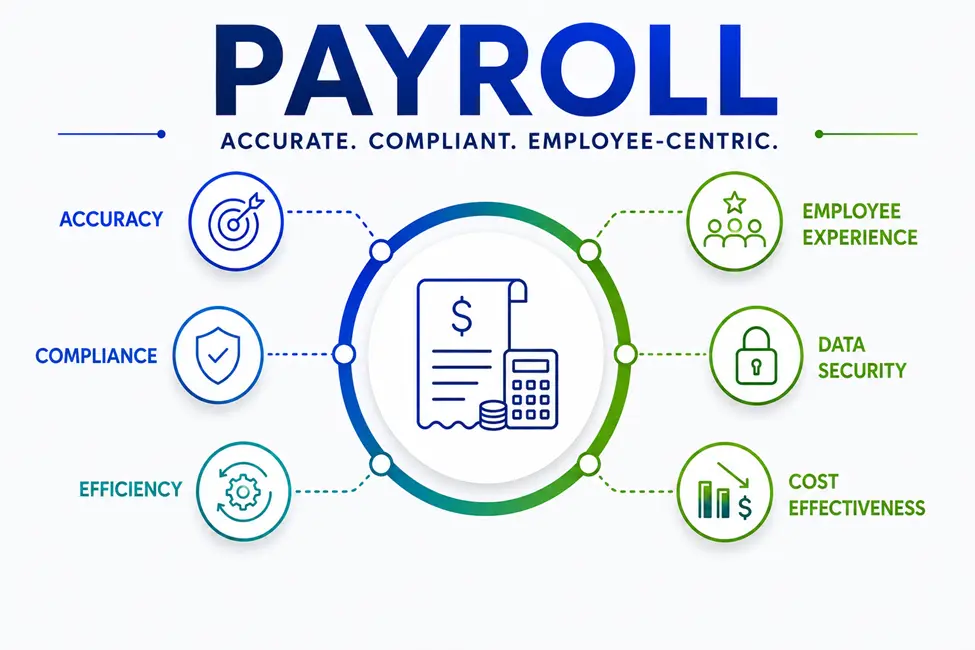
Payroll is a business-critical function that directly affects employee experience, financial control and regulatory compliance. Yet many organizations continue to manage complex payroll environments characterized by manual processes, fragmented workforce data and multiple technology platforms. Generative AI in Payroll is creating new opportunities to simplify knowledge-intensive work, improve employee support and help payroll teams manage exceptions more efficiently.
Realizing this potential requires more than adding generative AI to existing workflows. AI Transformation provides a broader framework for redesigning processes, data, technology, governance and workforce roles around intelligent capabilities. Together, Generative AI in Payroll and AI Transformation can help organizations build more efficient, responsive and insight-driven payroll operations.
This article explores how generative AI is changing payroll, its key applications and benefits, and the priorities organizations should consider when developing an AI-enabled payroll strategy.
What is Generative AI in Payroll?
Generative AI in Payroll refers to the use of generative artificial intelligence across payroll processes, employee support and payroll knowledge management. It can interpret natural language, summarize information, generate communications and help employees interact with payroll information conversationally.
For example, payroll teams can use generative AI to summarize complex cases, draft employee communications, retrieve relevant policies and explain common payroll concepts.
These capabilities complement traditional payroll automation by addressing knowledge-intensive activities that require interpretation, communication and access to information.
What is AI Transformation?
AI Transformation is the process of embedding artificial intelligence into business processes, operating models, technology environments and workforce practices to improve how an organization operates and creates value.
Rather than implementing individual AI tools independently, transformation considers how AI changes end-to-end workflows, employee roles, enterprise data requirements, controls and decision-making.
Within payroll, AI Transformation can involve redesigning payroll processing, employee service, exception management, analytics and compliance workflows around AI-enabled capabilities.
Why Generative AI in Payroll matters
Payroll teams manage high volumes of sensitive workforce and financial information while working within strict processing schedules. Employees also expect quick answers when questions arise about their pay.
Traditional self-service portals and rule-based automation can address many standardized activities, but more complex requests often require employees to search documentation or contact payroll specialists.
Generative AI in Payroll can improve access to payroll knowledge and summarize relevant information for employees and payroll teams. This reduces time spent searching for information while allowing specialists to focus on exceptions and complex issues.
How AI Transformation changes payroll
AI Transformation goes beyond automating individual payroll activities. It examines the complete process to determine how work should be redesigned when AI capabilities become available.
For example, instead of manually reviewing every transaction, AI can identify unusual patterns and direct payroll professionals toward potential exceptions. Generative AI can then summarize the relevant information to support investigation.
This creates a more exception-driven operating model where technology handles routine analysis and employees focus on activities requiring expertise, judgment and accountability.
Core technologies enabling intelligent payroll
Several technologies work together to modernize payroll operations.
Generative AI
Generative AI can summarize payroll cases, draft employee communications, retrieve policy information and support conversational employee self-service.
Machine learning
Machine learning can analyze historical payroll information to identify unusual transactions, recurring exceptions and patterns that warrant additional review.
Intelligent automation
Automation can streamline payroll validation, workflow routing, employee record updates and other repetitive activities.
Predictive analytics
Predictive analytics can help organizations anticipate payroll costs, overtime trends and workforce expenses using historical and operational information.
AI agents
AI agents represent an emerging capability that could coordinate multistep payroll workflows across HR, time management, payroll and finance systems while escalating exceptions requiring human judgment.
Together, these technologies expand Generative AI in Payroll from individual assistance toward more connected payroll operations.
Key use cases of Generative AI in Payroll
Organizations can apply generative AI across several payroll activities.
Employee payroll support
Generative AI can provide employees with conversational access to information about pay statements, deductions, payroll schedules and organizational policies.
Payroll case management
AI can summarize employee inquiries, identify relevant information and help payroll professionals understand complex cases more quickly.
Policy and knowledge management
Generative AI can make payroll policies and procedural documentation easier for employees and specialists to find and interpret.
Employee communications
AI can assist payroll teams in preparing clear communications related to payroll schedules, policy changes and common employee questions.
Exception management
Generative AI can summarize information related to potential payroll exceptions identified by machine learning or automated controls, helping specialists investigate issues more efficiently.
Payroll reporting
AI can generate initial summaries of payroll trends, workforce costs and operational performance for payroll and business leaders.
These applications demonstrate how Generative AI in Payroll can improve both employee service and payroll productivity.
Business benefits of AI Transformation in payroll
Combining AI Transformation with Generative AI in Payroll can improve several dimensions of payroll performance.
Greater payroll productivity
Automation and generative AI can reduce time spent on repetitive processing, information retrieval and routine employee inquiries.
Faster employee support
Conversational AI can provide immediate access to common payroll information and direct complex issues to the appropriate specialist.
More efficient exception management
AI can help identify and summarize potential issues, enabling payroll teams to focus attention where professional review is most valuable.
Better access to payroll knowledge
Generative AI can make policies, procedures and other payroll information easier to retrieve and understand.
Greater scalability
Intelligent workflows can help payroll teams manage increasing transaction and employee service volumes without equivalent increases in manual work.
Building an AI Transformation roadmap for payroll
Organizations need a structured approach to move from individual experiments toward scalable AI-enabled payroll operations.
A practical roadmap should:
- Assess current payroll processes and performance.
- Identify high-volume and knowledge-intensive activities.
- Evaluate payroll data and technology readiness.
- Prioritize AI use cases based on value, feasibility and risk.
- Simplify processes before introducing advanced automation.
- Integrate AI with payroll, HR, time management and finance platforms.
- Establish privacy, security and responsible AI governance.
- Define human oversight and escalation requirements.
- Measure productivity, service, cost and operational outcomes.
This approach helps ensure AI Transformation addresses business performance rather than focusing only on technology deployment.
Best practices for implementing Generative AI in Payroll
Payroll involves sensitive employee and financial information, making disciplined implementation particularly important.
Organizations should ensure generative AI only has access to information required for approved use cases. Role-based access controls and data security should be incorporated from the beginning.
Payroll knowledge sources should also be current and well governed. Outdated policies or inconsistent documentation can lead to unreliable AI-generated responses.
Human accountability should remain in place for payroll approvals, regulatory interpretation, employee disputes and other high-impact decisions.
Finally, organizations should continuously evaluate whether Generative AI in Payroll is improving employee service, productivity and payroll performance.
Common implementation challenges
Data fragmentation can create significant challenges for AI-enabled payroll. Employee information may reside across HR, payroll, time and attendance, benefits and finance platforms.
Legacy payroll systems can also make integration with modern AI technologies difficult.
Privacy and cybersecurity require particular attention because payroll contains highly sensitive employee and financial information. Organizations need clear controls governing how AI accesses, processes and retains this data.
Employee trust is equally important. Organizations should clearly define when AI is being used and provide appropriate routes to human payroll specialists when employees need additional support.
The future of Generative AI in Payroll
The next phase of Generative AI in Payroll will increasingly involve AI agents capable of coordinating activities across multiple workforce systems.
For example, an agent could identify a payroll exception, retrieve relevant employee and policy information, initiate an approved workflow and escalate the case to a specialist when human judgment is required.
Generative AI may also provide managers and payroll leaders with more conversational access to workforce cost and payroll performance information.
As these capabilities mature, AI Transformation will increasingly focus on redesigning payroll operating models, roles, controls and decision rights around collaboration between people and intelligent technologies.
Conclusion
Generative AI in Payroll is creating new opportunities to improve employee support, knowledge management and payroll productivity. Its greatest potential, however, emerges when AI is connected to broader process and operating model transformation rather than implemented as a standalone tool.
AI Transformation provides the framework for redesigning payroll around intelligent capabilities while maintaining the governance and human accountability required for a business-critical function. Organizations that combine strong payroll data, integrated technology, responsible AI controls and redesigned workflows will be better positioned to build efficient, scalable and future-ready payroll operations.
Also Read-4 Practical Ways To Stretch Any Tech Budget