
To achieve instant office privacy and reduce distractions, businesses can implement four simple solutions.
These practical office privacy ideas eliminate the need for costly, disruptive construction.
Managers can rethink spatial zones, deploy acoustic dividers strategically, create dedicated call areas, and install modular office pods.
Imagine a crucial video call interrupted by a loud conversation, or a sensitive meeting with nowhere to go.
Noise distraction consistently ranks as the top complaint in open-plan offices worldwide.
Research shows a significant drop in cognitive performance from conversational distraction alone.
Most businesses assume addressing this requires contractors, permits, and five-figure renovation budgets.
Fortunately, this is simply not true for modern workspaces. Four practical solutions can transform how a team works within days at a fraction of standard costs.
1. Rethink Your Zones for Focus-First Flow
Most open offices suffer from layout uniformity that practically guarantees maximum noise bleed.
When every square foot is treated identically, employees receive zero behavioral guidance on how to use the space.
The most effective open office solutions start with intentional spatial planning rather than purchasing new furniture.
Start by walking the existing floor plan to identify natural separation points. Look for underused corners near windows, low-traffic areas adjacent to walls, or wide corridors with dead ends.
Once identified, designate these distinct zones for heads-down focus work, collaborative discussion, and important calls.
Zoning operates as much psychologically as physically. Clearly labeled areas give employees permission to use space as intended.
This reduces the common habit of defaulting to noisy desks regardless of the task at hand.
A typical marketing agency can rearrange an open space into labeled zones using only existing furniture and basic panels.
When planning these zones, companies often explore flexible workspace upgrades that require zero construction.
For example, facilities managers can consider PrivacyPod’s acoustic work pods to quickly establish quiet areas.
2. Deploy Acoustic Dividers Strategically
A divider that blocks sightlines but transmits sound freely solves the wrong problem entirely.
To genuinely reduce office noise, dividers must address both visual and sound privacy simultaneously.
Prioritize freestanding panels made from pressed felt, recycled PET, or natural wood slats.
These materials are engineered to absorb sound rather than simply reflecting it into the room.
This effectively captures the exact frequency range of most conversational speech. Placement logic heavily dictates the overall acoustic effectiveness of these barriers.
Position panels perpendicular to the primary source of conversational noise to interrupt sound travel paths.
A single divider reduces transmission noticeably, while a U-shaped arrangement creates a highly focused microenvironment.
This targeted setup instantly protects a specific desk cluster from broader ambient noise.
Unlike constructed walls, acoustic dividers carry a distinct mobility advantage. They relocate with the team, requiring no demolition and no modification to the commercial lease.
With quality acoustic panels available at accessible price points, this represents a great starting point for immediate impact.
| Key Insight: Acoustic dividers must absorb sound, not just block sightlines. Pressed felt and wood slats capture conversational frequencies; place panels perpendicular to noise sources for measurable impact. |
3. Designate Dedicated Call Zones
Without clearly designated quiet spaces for calls, employees inevitably default to hallways, stairwells, and outdoor areas.
These workarounds signal a workplace that has not planned for how people actually work.
A common scenario involves an employee handling a sensitive conversation from a stairwell because every conference room is booked.
Coworkers on the open floor overhear enough to make the situation uncomfortable for everyone.
The problem here is not the judgment of the employee, but the absence of an obvious alternative.
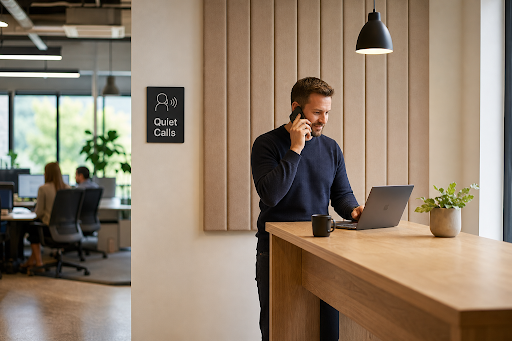
To fix this, managers must designate two to three call-friendly areas near windows or in low-traffic corners.
Equip these spaces with a sound-absorbing backdrop or a high-quality wall panel. Label them clearly so employees know the space is strictly intended for calls and virtual meetings.
Convenience ultimately determines adoption for any new office layout strategy.
If a quiet option is nearby and obvious, people will use it naturally instead of adding to ambient noise.
Still, a labeled corner with an acoustic panel is a starting point rather than a finish line.
When calls are frequent or confidential, informal zones fall short and structural solutions become necessary.
4. Install Modular Privacy Booths for Instant Quiet
Modern modular office pods are sophisticated, self-contained workspaces designed for serious acoustic isolation.
They feature studio-grade acoustic treatment, whisper-quiet ventilation, motion-activated lighting, and integrated charging ports.
These upgrades provide enough interior volume for genuine comfort during extended work sessions.
The strongest options in this category deliver highly effective noise reduction.
Studies show that acoustic interventions matter, as the mean binaural volume at standard workstations often exceeds 53 decibels.
Premium booths combat this by guaranteeing confidential conversations stay private while preventing external noise from disrupting focus.
Installation requires no drilling, no permits, and no modifications to existing building infrastructure.
Most units connect to a standard wall outlet and are ready to use the very same day. They serve as a flexible workspace upgrade that completely bypasses the delays of traditional construction.
For coworking operators, adding a smart-enabled pod serves as a premium amenity that converts idle square footage into usable workspace.
Because these pods move with the organization, they carry zero financial risk from stranded assets.
A relocated office never necessitates a new purchase, creating highly valuable, quiet spaces wherever the team goes.
| Key Insight: True soundproof pods deliver 30-35 dB reduction and full air refresh every 60 seconds. These specs ensure confidential calls and focused work without construction, unlike makeshift booths. |
The Bottom Line
These four office privacy ideas work independently or in combination. They scale easily to accommodate team size, budget constraints, and how frequently employees need quiet.
They are not competing strategies but a layered toolkit for open office solutions.
The clearest starting point is an honest behavioral audit of the workspace. Observe where employees actually go when they need to focus or take a confidential call.
The gaps in current behavior will reveal which privacy solution makes the most sense first.
Strategic zoning and acoustic dividers serve as fast, low-cost entry points that address ambient noise.
Conversely, modular office pods represent a structural investment that retains the flexibility to relocate.
Ultimately, the goal is to give teams real choices so focused work happens exactly where it needs to.
| Author Profile: PrivacyPod is the leading manufacturer of soundproof office pods and meeting booths for businesses seeking flexible, sustainable workspace solutions. |
Read more: Trade Exams | 4 Study Secrets | Pass Faster
Screen-Free Hobbies | End Fatigue
Hair Thinning Solutions | Low-Effort Fixes