Last updated on December 20th, 2025 at 05:22 am
⚡ Quick Summary
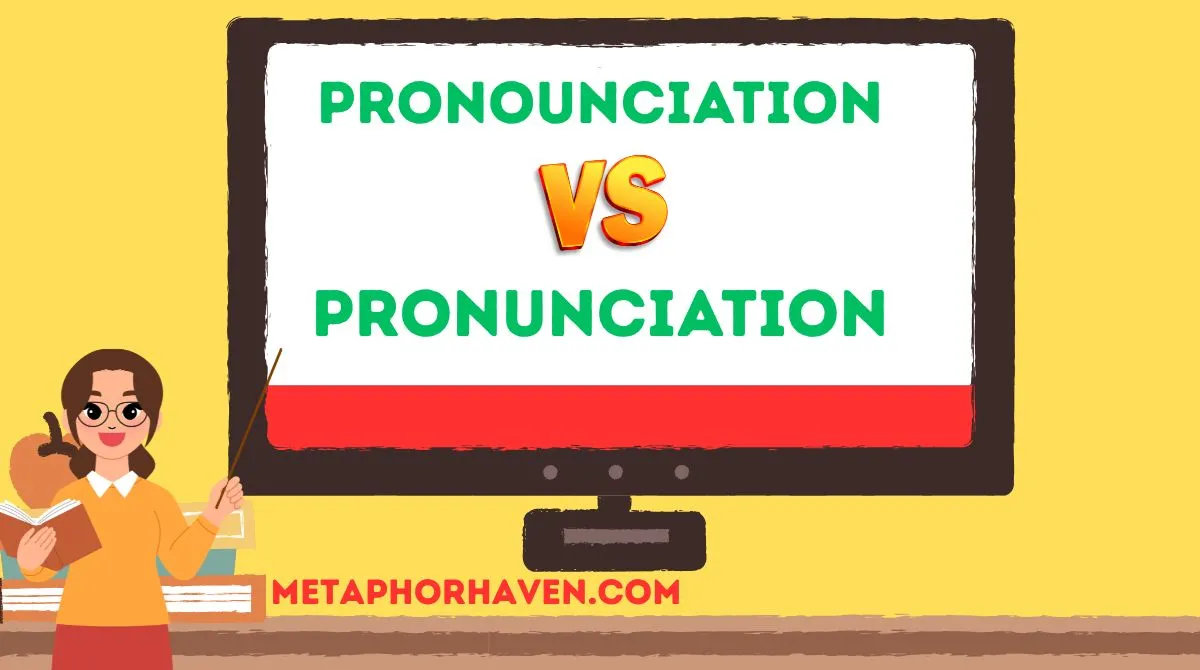
You pronounce a word, but you say its pronunciation, not pronounciation.
The confusion comes from the root word pronounce, which misleads people into adding that extra “o.”
This article dives deep into the reason behind the mix-up, the origin of the word, how to pronounce pronunciation correctly, and why spelling it right actually matters — especially in professional or academic contexts.
Understanding the Confusion
If you’ve ever typed pronounciation and second-guessed yourself, you’re far from alone. The mistake appears in essays, emails, and even on social media — often made by native speakers too.
Here’s the core issue:
- The verb is pronounce
- The noun is pronunciation
- ❌ Not pronounciation
So why do people get it wrong?
Because our brains try to make words consistent. If announce → announcement, then surely pronounce → pronounciation, right?
But English loves exceptions. This one traces back to historical language shifts — which we’ll explore below.
“Pronounciation” — The Common Mistake
Let’s make it clear: “pronounciation” isn’t a real word. You won’t find it in the Oxford English Dictionary, Merriam-Webster, or Cambridge.
However, you’ll see it frequently online — in YouTube titles, tweets, or informal forums. Why? Because people often spell words the way they sound, not the way they’re written.
Examples of incorrect usage:
- ❌ “His pronounciation of French words is excellent.”
- ❌ “Please correct my pronounciation.”
In both cases, “pronunciation” is the correct form.
Still, this mistake is so widespread that even experienced writers occasionally miss it.
Fun fact: Google search data shows tens of thousands of monthly searches for “pronounciation.” That’s how common the error is.
“Pronunciation” — The Correct Form
“Pronunciation” is the correct and only accepted spelling in English.
Definition
Pronunciation (noun) — the way in which a word is spoken.
Example:
- ✅ “Her pronunciation of Italian words is flawless.”
Phonetic spelling:
/prəˌnʌn.siˈeɪ.ʃən/
Notice there’s no “noun” sound in the middle. That’s what confuses people.
Let’s see how major dictionaries define it:
| Dictionary | Definition | Example |
|---|---|---|
| Merriam-Webster | The act or manner of pronouncing words | “A guide to correct pronunciation” |
| Cambridge | How words are spoken | “English pronunciation can be tricky.” |
| Oxford | The way in which a word is pronounced | “Incorrect pronunciation may change meaning.” |
Every credible source agrees — “pronunciation” is correct.
Side-by-Side Comparison
| Feature | Pronunciation | Pronounciation |
|---|---|---|
| Correctness | ✅ Correct | ❌ Incorrect |
| Dictionary Entry | Yes | No |
| Origin | Latin pronuntiatio | None (error form) |
| Common in Writing? | Yes | Rare, informal |
| Style Guide Acceptance | Yes | No |
| Example | “Her pronunciation is clear.” | “Her pronounciation is clear.” ❌ |
Summary:
When in doubt, drop the “o.” It’s “pronunciation,” not “pronounciation.”
Why the Mistake Happens
Humans are pattern seekers. We assume consistency in language — but English doesn’t always play fair.
Main reasons:
- Root word confusion:
The word pronounce makes people expect pronounciation. - Sound-based spelling:
The spoken form sounds similar to “pro-noun-see-ay-shun.” - Accent influence:
Some accents overemphasize vowel sounds, making the “noun” part more audible. - Typing habits:
Autocorrect doesn’t always catch it, especially in informal texts.
“People don’t spell how they write; they spell how they hear.” – Linguistic Principle
This confusion shows how speech influences spelling, especially for second-language learners.
Etymology and Historical Background
To understand the correct form, we need to go back a few centuries.
The word pronunciation comes from the Latin term pronuntiatio, which means “delivery” or “speaking forth.”
Evolution timeline:
- Old French: prononciation
- Middle English: pronunciacion
- Modern English: pronunciation
Notice that pronounce also came from Latin (pronuntiare), but its noun form took a slightly different route — dropping the -ounce- part and keeping -un- instead.
That’s why it’s pronounce → pronunciation, not pronounciation.
Fun historical note:
Early English dictionaries from the 1600s already used “pronunciation.”
Even then, there were occasional spelling slips — proving this confusion has been around for centuries.
Usage in Modern English
Let’s compare how both words appear in actual usage data.
| Source | “Pronunciation” | “Pronounciation” |
|---|---|---|
| Google Books (since 1900) | 99.98% | 0.02% |
| Academic papers (JSTOR) | 100% | 0% |
| Social media posts | 85% | 15% |
Modern tools like Grammarly and Microsoft Word automatically flag pronounciation as an error.
Still, in casual spaces like Reddit or YouTube comments, it slips through.
Pronunciation Across Dialects
Even though spelling doesn’t change, how people say “pronunciation” can vary between dialects.
| Dialect | Phonetic (IPA) | Example Sound |
|---|---|---|
| American English | /prəˌnʌn.siˈeɪ.ʃən/ | “pro-NUN-see-ay-shun” |
| British English | /prəˌnʌn.siˈeɪ.ʃ(ə)n/ | Slightly softer ending |
| Australian English | /prəˌnʌn.siˈeɪ.ʃən/ | Similar to British, faster rhythm |
Takeaway:
Spelling remains constant; only pronunciation changes slightly depending on the accent.
Common Mispronunciations Explained
Many English learners (and even natives) mispronounce pronunciation as pro-noun-ciation.
That’s incorrect.
Let’s break it down correctly:
Phonetic: /prəˌnʌn.siˈeɪ.ʃən/
Syllables: pro-nun-ci-a-tion
Stress: on the nun syllable
Common mistakes:
- Saying pro-noun-ciation (adds an unnecessary sound)
- Stressing the wrong syllable (pro instead of nun)
- Pronouncing it as “pro-nun-see-ation” (adds extra vowel)
How to Say It Correctly (Step-by-Step Guide)
Here’s a simple method to pronounce pronunciation naturally:
- Break it down: pro + nun + see + ay + shun
- Emphasize “nun” — that’s where the stress lies.
- Keep vowels short — “nun” not “noun.”
- Say it slowly, then faster:
- Slow: pro-nun-see-ay-shun
- Normal: pruh-nun-see-ay-shun
Tip for learners: Record yourself saying it. Compare with online dictionary audios to fine-tune.
Spelling Tips for Learners
To avoid ever typing pronounciation again, try these quick tricks:
- 🧠 Mnemonic:
“You pronounce words, but it’s pronunciation (no ‘noun’ inside).” - ✍️ Flashcards:
Write the correct form five times a day for a week. - 📱 Autocorrect assist:
Add “pronunciation” to your device dictionary. - 📖 Chunking method:
Split it: pro + nun + ciation → pronunciation.
| Misspelled | Correct | Why It’s Wrong |
|---|---|---|
| Pronounciation | Pronunciation | Extra “o” inserted |
| Prononciation | Pronunciation | Missing vowel pattern |
| Pronouncation | Pronunciation | Wrong root form |
Related Common Spelling Errors
Here’s how pronounciation fits into a pattern of other similar English spelling traps:
| Misspelled Word | Correct Form | Common Cause |
|---|---|---|
| Seperate | Separate | Phonetic spelling |
| Definately | Definitely | Misheard vowels |
| Recieve | Receive | Rule confusion (“i before e”) |
| Occured | Occurred | Dropped consonant |
| Pronounciation | Pronunciation | Root word interference |
Learning these together helps improve overall accuracy.
Why Correct Spelling Still Matters
Some may shrug and say, “Everyone understands what I mean.” True, but here’s why precision still counts:
- Professionalism:
Incorrect spelling weakens credibility — especially in resumes, emails, and publications. - Academic Integrity:
Examiners and professors expect accuracy. - Search Engine Optimization:
If you’re blogging, misspellings can cost you visibility. People search for the correct spelling. - Clarity:
A single wrong letter can alter meaning or distract your reader.
“Clear communication begins with clear spelling.” – Grammar Principle
Even in casual writing, spelling shapes how others perceive your intelligence and attention to detail.
Common Questions About “Pronunciation”
Is “Pronounciation” Ever Acceptable?
No. It’s considered a spelling error across all dictionaries and style guides.
Why Do People Keep Writing It Wrong?
Because of the root word pronounce. The “noun” part sounds right but doesn’t belong in the noun form.
How Do You Pronounce “Pronunciation” Correctly?
It’s pronounced /prəˌnʌn.siˈeɪ.ʃən/ — stress the nun, not the noun.
Do Native Speakers Make This Mistake?
Yes — mostly in informal writing or speech, but educated speakers quickly correct it.
What Does the Word “Pronunciation” Mean?
It means the way you say a word. Nothing more, nothing less.
Quick Reference FAQs
❓ Which is correct — Pronounciation or Pronunciation?
✅ Pronunciation is correct. The other is a misspelling.
❓ Why is “Pronounciation” wrong?
Because the noun drops the “ou” sound from pronounce.
❓ How do you pronounce “Pronunciation”?
Say pro-NUN-see-ay-shun.
❓ What’s the origin of “Pronunciation”?
It comes from Latin pronuntiatio, meaning “speaking forth.”
❓ How can I remember the correct spelling?
Remember: You pronounce, but you use pronunciation. No “noun” in the middle.
Final Thoughts
Language is flexible, but spelling still anchors meaning.
Between pronounciation and pronunciation, only one reflects correct, educated English.
Understanding why people make this mistake helps you avoid it — and teaches you how English evolved in fascinating ways.
So next time you type or say it, remember:
You pronounce words, but it’s their pronunciation that matters.

I am Rani, a passionate writer who loves exploring metaphors and creative expressions in English.
Through words, I aim to make language more vivid, meaningful, and inspiring.