
Last updated on December 20th, 2025 at 05:35 am
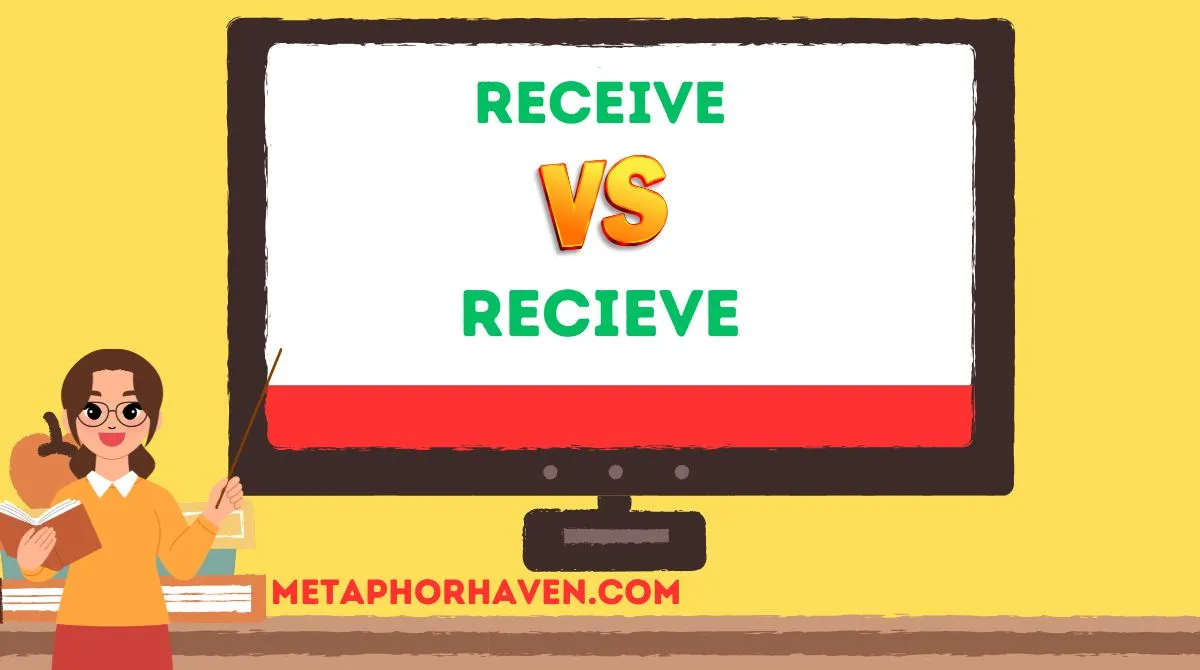
Spelling mistakes might seem small, but one wrong letter can change how people perceive your writing. Among the most common errors is “recieve” vs. “receive.” Many writers, students, and professionals stumble over this word. The good news? Once you understand the rule, the meaning, and some memory tricks, you’ll never misspell it again.
This guide dives deep into why people get confused, the correct spelling, its origins, pronunciation, common mistakes, and practical exercises to master “receive.”
Why the Confusion Between “Recieve” and “Receive” Exists
English spelling is tricky. Some words sound one way but are spelled differently. “Receive” is one of them.
- Phonetically, “receive” sounds like “re-seev,” which tempts writers to swap the i and e.
- Informal writing, social media, and typing quickly increase mistakes.
- The “I before E except after C” rule confuses learners, especially when exceptions exist in English.
Even advanced writers sometimes type “recieve” out of habit. Understanding the confusion is the first step to correcting it.
Understanding ‘Recieve’ – Why It’s Wrong
Simply put, “recieve” is incorrect.
Breaking Down the Error
- Many assume “i before e” always works.
- After c, English spelling flips the letters: e before i.
- Typing fast or relying on pronunciation often leads to recieve.
Examples of Incorrect Usage:
- I will recieve your email tomorrow.
- She didn’t recieve the invitation.
These errors are easy to spot once you know the rule.
Understanding ‘Receive’ – The Correct Spelling
Definition
Receive (verb) means to get, accept, or be given something.
Examples:
- I receive letters every morning.
- They received a warm welcome at the party.
Etymology
- Originates from Latin recipere, meaning “to take back” or “accept.”
- Entered English in the 14th century and has retained its spelling since.
Pronunciation and Syllables
- Pronounced /rɪˈsiːv/
- Syllables: re-ceive
Common Synonyms
- Accept
- Obtain
- Acquire
- Get
Knowing these synonyms helps you understand the word’s usage in context.
The “I Before E Except After C” Rule
Rule Explained
- i before e works in most words: believe, field, achieve.
- e before i after c is correct in words like receive, ceiling, perceive.
Exceptions
English loves exceptions:
- Weird, neighbor, their, foreign
Mnemonic Tips
- “I before E, except after C, or when sounding like A, as in neighbor and weigh.”
- Picture the word receive as C comes first, then EI to lock the memory.
Side-by-Side Comparison: Recieve vs. Receive
| Word | Correct? | Meaning | Example Sentence |
|---|---|---|---|
| Recieve | ❌ Wrong | None | I will recieve your package tomorrow. |
| Receive | ✅ Correct | To get or accept | I will receive your package tomorrow. |
This table makes it easy to see which spelling is correct and why.
Practical Tips to Remember Correct Spelling
- Visualize the C first, then EI.
- Say it aloud: re-ceive, emphasizing the “e” sound after “c.”
- Repeat writing it multiple times to reinforce muscle memory.
- When proofreading, highlight ie/ei words after c.
Everyday Usage of ‘Receive’
Receive appears in many contexts:
- Emails: I received your message.
- Gifts: She received a birthday present.
- Payments: The company received payment yesterday.
- Notifications: You will receive an alert when your package ships.
Examples in Sentences:
- Did you receive my email?
- They received excellent feedback from the teacher.
- Everyone who attended received a certificate.
Strategies for Self-Correction
Proofreading Tips
- Slow down and read carefully.
- Focus on words with ie/ei patterns.
- Ask, “Does this look like receive or recieve?”
Recommended Tools
- Grammarly
- Microsoft Word spell check
- Hemingway Editor
Exercises for Reinforcement
Fill-in-the-Blank
- I will ________ your application tomorrow. (receive)
- Did you ________ the invitation? (receive)
Word Matching
Match the synonyms:
- Obtain → Receive
- Get → ________
Writing Prompt
Write 5 sentences using receive in everyday life, like emails or gifts.
Other Frequently Misspelled Words
Words following similar patterns:
- Believe vs. Beleive
- Achieve vs. Acheive
- Ceiling vs. Cieling
- Perceive vs. Perceve
Tip: Apply the same “C + EI” memory trick.
FAQs About ‘Receive’ vs. ‘Recieve’
What is the correct spelling?
Receive is the correct spelling.
Why do people write ‘recieve’?
Many follow pronunciation rules or misapply “i before e” patterns.
Does the “I before E except after C” rule always work?
No. English has exceptions like neighbor, weird, and foreign.
Can I use ‘recieve’ in professional writing?
No, it is considered incorrect and unprofessional.
What’s the best way to remember the spelling?
Use the mnemonic: “C comes first, then EI”, and practice writing it.
Conclusion
Spelling receive correctly might seem minor, but it reflects professionalism and attention to detail. Remember the rule: “I before E except after C” and visualize C → EI.
Practice using receive in emails, letters, and everyday writing. Avoid the common trap of typing recieve by proofreading carefully, using tools, and reinforcing through exercises. Over time, correct spelling becomes second nature.

I am Rani, a passionate writer who loves exploring metaphors and creative expressions in English.
Through words, I aim to make language more vivid, meaningful, and inspiring.