
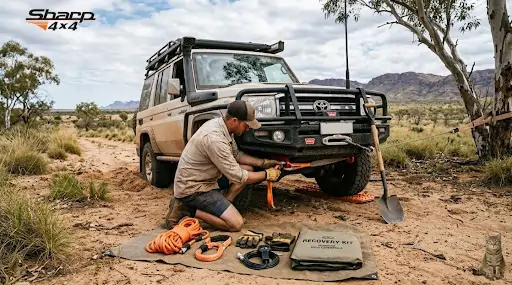
Travelling alone across Australia provides one of the best chances to enjoy life on the road. There’s nothing more liberating than loading up your rig, turning west towards the red dirt, and leaving the ‘civilisation’ behind to travel the incredible outback! The downside of going alone is that you’re also your own safety net.
When you get buried in sand or slide into a mud puddle, your only chance of getting out is through having a proper recovery kit. Otherwise, there is nothing to prevent a disastrous day trip. Sadly, many drivers will load up their 4WD with gear they do not know how to use. Below we will outline the absolute ‘must-haves’ for an individual setup.
Establishing Proper Foundations First
Before you even look at buying bags of straps and ropes, you need to ensure your vehicle is actually ready to be recovered. The most expensive recovery gear on the market is entirely useless if you have nowhere safe to attach it. Factory tie-down loops are not designed to handle the massive forces generated when pulling a three-tonne four-wheel drive out of a bog.
You must invest in properly rated recovery points bolted directly to your chassis. If you are unsure about your current setup, it pays to consult with a specialist in 4WD accessories and touring setups to get rated points installed properly by the experienced installation team. A factory-made shear point can be deadly, so this is step one for any serious tourer.
The Solo Operator’s Arsenal
When travelling by yourself, it is very important that the gear you use is designed to help you recover from a difficult situation. A traditional snatch strap is a suitable option to help recover if you have someone else with you in another vehicle, but a kinetic rope and a powerful set of traction boards provide the best option for recovering from a difficult situation if you are alone. The main reason for using a kinetic rope over a traditional snatch strap is that it can stretch much more than a snatch strap can, which means you have a much smoother pull on the vehicle from which you are trying to recover.
Another important point to remember when using a kinetic rope or a traction board is that, instead of using heavy metal D-ring connectors to attach the two together, you should use soft shackles to attach them together. The main reason for this is that the soft shackles are much lighter than the metal D-rings, will float in the water, and will not become dangerous projectiles if a line breaks from underneath a high amount of tension.
Mastering the Heavy Lifting
If you are exploring truly remote tracks, you cannot rely on another traveller coming along to pull you out. This is where an electric winch becomes completely non-negotiable for the solo tourer. Understanding winch basics is just as important as owning the winch itself. You need to know how to safely unspool the line, rig up a tree trunk protector to preserve the environment and perform a single or double-line pull using a snatch block.
Quality matters immensely here, so sourcing your equipment from a trusted off-road equipment supplier ensures you have a winch motor that will not burn out when you are bogged up to the axles. You might also want to chat with the touring build experts to ensure your vehicle’s electrical system and dual batteries can actually handle the heavy power draw of a prolonged winch recovery.
FAQs
Do I need a winch for solo 4WD touring?
Yes, an electric winch is strictly essential for solo trips because it allows you to self-recover without relying on another vehicle.
Why should I use soft shackles instead of metal ones?
Soft shackles are lighter, float in muddy water, and are much safer since they will not become heavy metal projectiles if a line snaps.
Can I use a factory tie-down loop for vehicle recovery?
No, factory tie-downs are only designed for shipping transport; you must always use load-rated recovery points bolted directly to your chassis.
What is the main advantage of a kinetic recovery rope?
Kinetic ropes offer significantly more stretch than traditional snatch straps, delivering a smoother pull that reduces shock load on your 4WD components.
The Mental Checklist and Forgotten Items
One way to make sure you never go somewhere unprepared is to develop a mental recovery kit checklist. However, it is frequently the inexpensive items that end up in the shed, rather than the costly items that usually get packed into the vehicle.
For instance, some people can spend thousands of dollars for suspension and winches but end up leaving behind something as simple as a long-handled shovel that they could have used to clear dirt or sand out from underneath their differentials.
Heavy-duty leather rigger gloves are constantly forgotten, yet they are vital for handling winch cables, moving hot vehicle components, and clearing sharp scrub. A heavy winch dampener is another essential that is frequently overlooked but required by law in many clubs for safe winching.
Getting your setup sorted by a recognised name in Australian 4WD accessories or an overlanding equipment supplier like Sharp 4×4 usually means you will get pointed towards these smaller, life-saving items before you head bush.
The outback can be difficult to navigate, but if you have a well-organised kit, it can make all the difference. Keep it basic, have all parts rated for their intended purposes, and know how to use everything that you take with you.
Read more: Stylish and Functional Vanity Solutions for Modern Bathrooms – metaphorhaven.com
How Smart Start Interlocks Are Revolutionizing Safe Driving and DUI Prevention – metaphorhaven.com
Why more riders prefer to order motorcycle online in the UAE